10 Trends Reshaping the Global Space Economy: Insights from World Space Business Week 2026

From launch certainty and sovereign space capabilities to AI-driven Earth observation and Direct-to-Device connectivity, discover 10 trends shaping the global space economy, based on industry discussions at World Space Business Week 2026.
Space Defense at an Inflection Point: From Investment to Operational Capability

At SDSS 2026, Novaspace CEO Pacôme Révillon explored the forces reshaping space defense, from accelerating government investment and sovereign constellations to resilient architectures, interoperability and the growing challenge of turning investment into operational capabilities.
Sovereignty, Cooperation and Resilience in an Increasingly Contested Space Domain | Insights from SDSS 2026

SDSS 2026 highlighted how sovereignty, resilience and cooperation are reshaping space defense and security. From multi-domain operations and GEOINT to secure connectivity, procurement and space domain awareness, discover the key trends discussed by military, government and industry leaders in Paris.
From Innovation to Scale: 7 Trends Shaping the Space Economy | SPIN 2026
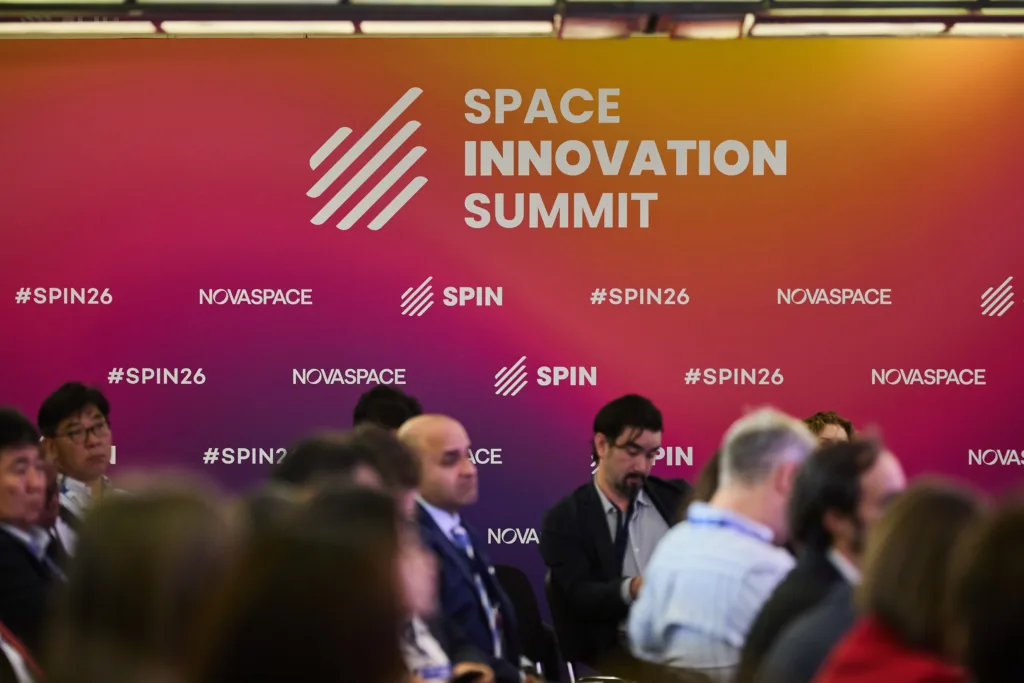
SPIN 2026 highlighted a space economy moving from technological demonstration to commercial and industrial scale. Discover seven trends shaping its next phase, from AI and orbital computing to sovereignty, defense demand, investment and new cross-sector partnerships.
Commercial Defense Satcom Service Revenues to Surpass $22.6B by 2035
Paris, France | September 2026 — Novaspace’s Satellite Communications for Defense and Security, 2nd Edition highlights a defense Satcom market poised for rapid growth. By 2035, commercial satellite service revenues are projected to exceed $22.6 billion, while global defense Satcom demand is forecast to surpass 7.5 Tbps, driven by the adoption of next-generation non-geostationary orbit (NGSO) constellations.
Why Scaling in Defense Follows Different Rules

Private investment in defense has surged to $11 billion in 2025, but capital alone doesn’t guarantee scale. Long procurement cycles, entrenched primes, and fragmented national markets mean defense start-ups face a different playbook than typical deep-tech ventures. Novaspace’s PAVED framework — Prioritize dual-use, Acquire operational support, Vertically integrate, Establish prime partnerships, Diversify funding — outlines the five strategic priorities that separate companies who scale from those stuck in the “valley of death.”
Centre for Space Futures, Novaspace and SpaceTech Gulf Sign Agreement to Develop Global Space Capability Mapping Dashboard
The Centre for Space Futures, Novaspace and SpaceTech Gulf have signed a Memorandum of Cooperation to develop a Global Space Capability Mapping Dashboard. The initiative will provide governments, industry leaders, investors and researchers with a trusted, data-driven platform to benchmark national space capabilities, identify expertise, and accelerate international collaboration across the global space economy.
D2D Market Evolution: The Case Beyond Consumer Demand

Direct-to-device (D2D) satellite connectivity is rapidly evolving beyond consumer services. In this joint Novaspace and BCG white paper, explore the market trends, strategic value pools, investment dynamics, and emerging opportunities across government, defense, sovereign communications, and industrial IoT.
Space Data Centers: The Next Frontier for AI and Cloud Computing
As AI drives unprecedented demand for computing power and energy, space data centers are emerging as a potential new frontier for digital infrastructure. This Novaspace white paper explores the technologies, economics, use cases, and market dynamics shaping the future of orbital computing and space-based AI infrastructure.
From Experimentation to Operations: Key Insights from Novaspace at Space Symposium 2026
At Space Symposium 2026, Novaspace brought together global leaders to explore how artificial intelligence is reshaping space systems. Discussions revealed a clear transition from experimentation to operational deployment, with AI driving advances in space computing, interoperability, and defense applications. As trust, power constraints, and real-time decision-making take center stage, the industry is entering a new phase of AI-enabled space operations.