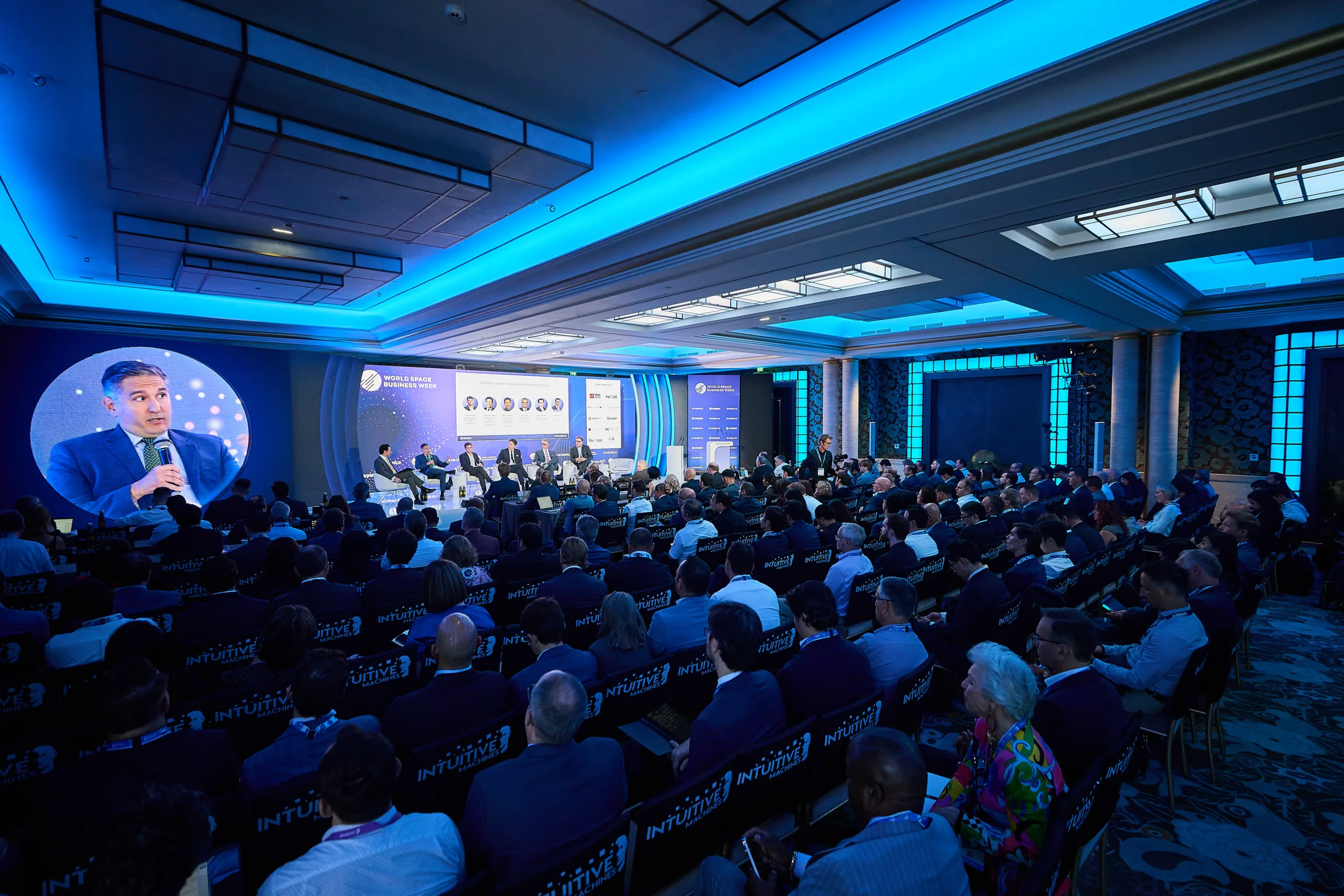
From September 14 to 16, 2026, Paris once again brought together the global space and satellite community for World Space Business Week (WSBW). The event convened senior executives, policymakers, investors and innovators from across the space ecosystem, offering a comprehensive view of the forces shaping the next phase of the space economy.
Across panels, keynotes and industry discussions, a clear message emerged: space infrastructure is becoming increasingly strategic, with sovereignty, defense requirements and commercial sustainability influencing investment and business decisions.
Upstream, the challenge is to achieve greater scale and resilience across launch, manufacturing and operations, amid a market increasingly shaped by non-geostationary orbit (NGSO) constellations. Downstream, value is shifting toward integrated connectivity and data services, with artificial intelligence (AI), multi-orbit architectures and Direct-to-Device (D2D) technologies transforming how space capabilities are delivered to end users.
Drawing on discussions throughout WSBW 2026, Novaspace identifies ten key trends shaping the industry’s evolution.
- Launch certainty is becoming more valuable than price
Discussions around the potential retirement of SpaceX’s Falcon 9 from the commercial market around 2030 were echoed throughout the conference, raising questions among satellite operators in Western markets about long-term launch availability and prompting them to reassess their strategies and consider alternatives. Ensuring access to space is becoming a key priority, alongside price and frequency. Firefly, Blue Origin and Arianespace stated that customers are now placing greater emphasis on schedule certainty, reliability and launch cadence. In this context, launch service providers are under pressure to ramp up operations and convert their order books into reliable capacity.
- Private investment continues to flow into the space industry
Another $553 million in funding was announced during the conference (by Open Cosmos and EnduroSat), adding to the $15.7 billion* raised so far in 2026, highlighting how space remains attractive to private investors. Capital inflows and market shifts are also driving M&A activity. Panelists noted that around 60 mergers and acquisitions (M&A) deals are expected in the space sector this year, continuing the trend observed over the past five years. Around three-quarters of space M&A transactions involve companies active in both the space and terrestrial sectors, showing that investors view space as a strategic asset embedded in end-to-end solutions rather than merely as a technological ambition.
Includes all pre-IPO series, SPACs and IPOs from 2026, excluding SpaceX’s IPO in June.
- Sovereignty is increasingly driving mission procurement
ESA and NOAA stressed at the conference how public institutions are increasingly translating government priorities into demand for sovereign connectivity, Earth observation, launch and dual-use capabilities. Meanwhile, Safran, Leonardo and financial investors stressed that political ambition alone will not create industrial scale: companies need early demand signals, faster procurement and long-term contracts before they can invest confidently in factories, fleets and supply chains.
- Vertical integration is one solution, but not the only one
The pursuit of vertical integration was one of the recurring themes at WSBW, across all sectors of the industry. Several players, including Rocket Lab and SES, argued that greater control over critical assets across the value chain can improve resilience, ensure on-time delivery and optimize value creation. However, other players, such as ReOrbit, Open Cosmos and Muon Space, emphasized that integration is not always the best strategy. In some cases, companies should retain control over capabilities essential to their missions while leveraging external expertise and partnerships when these help accelerate innovation, growth and time to market.
- The shift toward standardized satellite production is gaining momentum
Satellite and subsystem manufacturers have long anticipated a shift from bespoke hardware toward industrial production, driven by constellation demand, higher power requirements and more complex mission profiles. This transition is now becoming a reality, as highlighted by satellite manufacturers Muon Space and Open Cosmos, and subsystem makers ThrustMe and CesiumAstro. Still, the objective is not complete standardization and universality, but to standardize the elements that can be replicated while retaining flexibility to tailor missions, suppliers and software to customer needs.
- Sovereign demand is creating new opportunities for GEO
Although GEO’s share of the satellite connectivity market is declining, GEO infrastructure is evolving rather than disappearing. GEO filings have increased by 50%, according to an ITU representative speaking at the conference. This growth is driven by emerging and developing countries seeking sovereign communications capabilities and the evolution of GEO infrastructure. For instance, just prior to the event, Saudi Arabia’s STC Group ordered an Astranis Small GEO, adding to the 10 small GEO satellites ordered over the past two years. At WSBW, NSG signed an MoU with Hispasat, exploring a framework for the Spanish company to use the Ka-band HTS capacity of SGS-1, the Saudi sovereign satellite. Nigeria also advanced its sovereign satellite ambitions by selecting Thales Alenia Space for its NigComSat-2A satellite.
- The ground segment is becoming a critical integration layer
As networks add satellites, orbits, data sources and users, the ground segment is becoming a software-defined orchestration layer where interoperability matters as much as capacity. Aalyria and Warpspace illustrated this shift through their work on integrated optical communications and network interoperability. Yet panelists stressed that speed cannot come at the expense of cybersecurity and resilience: future architectures must assume that individual nodes and links may be disrupted.
- D2D is gaining momentum, but commercial demand remains uncertain
Direct-to-Device (D2D) technology is evolving from a simple coverage-extension solution into a broader connectivity layer for the public. Panelists emphasized that its success will depend on spectrum, capital, access to space, vertical integration and partnerships with mobile network operators. SES and Elveo announced their plans to develop a D2D constellation in Europe, while the signing of a binding agreement between Space42 and Viasat to formally establish Equatys illustrates the push to share infrastructure and capital. Yet demand remains difficult to assess, leaving operators uncertain about how to position and commercialize these services.
- From imagery to reliable and actionable intelligence
Earth observation is shifting from selling images and raw data to providing information that can be directly used and integrated into operational workflows. Xoople and L3Harris illustrated this move through their planned AI-focused constellation, while MDA Space’s CHORUS portfolio reflects a similar shift toward integrated EO services. Persistence, data fusion and onboard processing can shorten the path from data collection to decision-making. However, as AI takes on a greater role in detection, characterization and tasking, the competitive challenge will be to balance speed with trust, reliability and relevance.
- In-space servicing moving from concept to capability
In-orbit services have moved beyond isolated demonstrations, as mission extension, inspection, relocation and maneuverability become increasingly important for commercial and sovereign operators. Katalyst and Northrop Grumman highlighted the growing importance of robotic servicing and life-extension capabilities. The next challenge is to transform custom-built capabilities into standardized, miniaturized and reliable products. In the meantime, as Exotrail emphasized, companies can leverage IOD/IOV and last-mile delivery (LMD) markets to access early revenues while their full servicing capabilities are still being developed.
Looking Ahead: From Space Assets to Space Infrastructure
The defining message emerging from WSBW 2026 was not a single technology or market segment. It was the convergence of several transformations happening simultaneously.
Space is becoming more strategic to governments. Manufacturing is becoming more industrialized. Operators are moving closer to end users. AI is changing how data is processed and monetized. Connectivity is becoming more integrated with terrestrial networks. And partnerships are becoming essential to achieving scale.
Together, these developments point toward a broader evolution of the space economy: from building individual space assets to building integrated infrastructure and services.
This transition will reshape where value sits across the industry. Competitive advantage will increasingly depend not only on technological performance, but on the ability to industrialize, integrate, secure access to markets, build strategic partnerships and translate space capabilities into outcomes for customers.
WSBW 2026 offered a snapshot of an industry moving rapidly in that direction. The next phase will be defined by which organizations can turn that momentum into scalable, resilient and commercially sustainable capabilities.
Save the date: World Space Business Week returns to Paris on September 13–16, 2027, for its 30th edition.