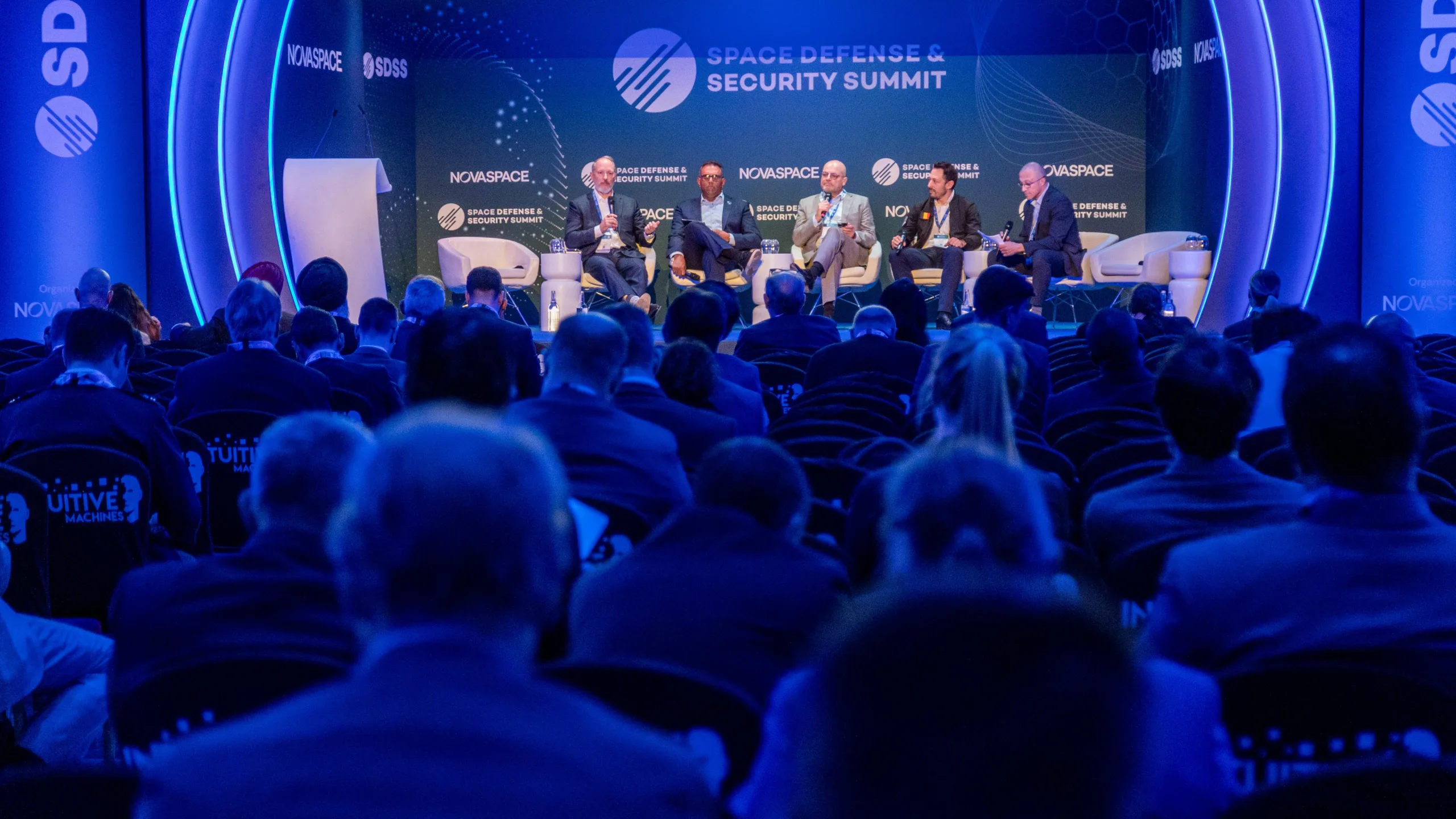
Held alongside World Space Business Week as part of The Space Week, the third edition of the Space Defense & Security Summit (SDSS) brought together over 600 attendees from over 30 countries, spanning military leaders, government agencies, industry executives, and international organizations.
Held on September 15–16, 2026, at the Salons Hoche in Paris, SDSS explored how the militarization of space has changed national and industrial priorities around sovereignty within the shifting landscape of space defense cooperation.
Space as a Key Military Enabler
The war in Ukraine has called into sharp relief how space-based capabilities shape large-scale combat operations. Dependence on space-enabled services—communication and navigation for the civil sector, and early warning and ISR for the defense sector—underpins modern military operations.
Military and industry panelists alike observed that integrating space-based capabilities into defense operations doesn’t stop at the command suite—it will require education and training for service members relying on data from assets in space. Joint exercises including space and directing space capabilities to military requirements will enhance long-term enablement.
The Changing Definition of Sovereignty
Discussions at SDSS reflected a broader evolution in how governments define sovereignty in space. One speaker noted that sovereignty is no longer just ownership, but also control and localization of capabilities. At the same time, sovereign capabilities cannot operate in isolation. Regional shifts are in progress to ensure interoperability keeps pace with sovereign innovation.
NATO—through its HALO initiative, for example—will seek to function as an integration layer for national military space assets, improving collective coverage, capacity and resilience. Coordination amongst allies with sovereign space defense capabilities is becoming more imperative. Sovereignty and cooperation are becoming complementary requirements.
Integrating Space into Multi-Domain Operations
The integration of space into multi-domain operations (MDO) involves more than adding another set of capabilities to an existing operational architecture. Armed forces also need to understand and stress-test their dependence on space services.
Air and maritime superiority, for example, now come from space security. Space is an integrated node within MDO, connecting sensors, decision nodes, and effectors. Disruption in space can create immediate operational effects across other domains. Growing the scale of MDO requires technological solutions to process bottlenecks—like leveraging automation and AI, processing closer to sensors, and using space for tipping and cueing.
GEOINT Enabling Operational Decision-Making
Speakers in military leadership and industry affirmed that the speed of dissemination of geospatial intelligence (GEOINT) is a key constraint on operational decision-making. GEOINT fuses data from ground and space sensors, relies on multi-sensor architectures, and balances trade-offs between speed and accuracy.
From the military perspective, the future of GEOINT includes AI or automation technologies to support analyst productivity. Industry speakers, meanwhile, described defense customers increasingly as long-term development partners. Their requirements are pushing toward scalable manufacturing, higher revisit rates, lower latency and rapid processing. Providing governments with sovereign GEOINT capabilities requires a high degree of customer trust.
Planning for Resilience and Interoperability
Increased emphasis on sovereign space defense capabilities means that maintaining interoperability with allies requires dedicated resources, personnel, and exercises. National space leaders at SDSS repeatedly emphasized their focus on cooperation as they continue pursuing sovereignty.
In a militarized space domain, this includes establishing common architectures and standards, command and control environments, and selective integration of capabilities.
Secure Connectivity and Communications in Contested Environments
Secure connectivity is moving beyond the provision of satellite bandwidth toward integrated, mission-oriented services combining multiple networks, orbits and terrestrial infrastructure. This shift changes how governments assess readiness. An ESA speaker described defense readiness in terms of the ability to provide a secure service when it is required, with both available capacity and service quality playing central roles.
In Europe, this means implementing IRIS2 as a system of systems—a backbone to other services—with a revised architecture that increases capacity by 60%. The wider implication is that secure communications architectures are becoming more distributed and interconnected.
Government-Commercial Relationships are Reshaping Defense Procurement
Space defense procurement is changing alongside the capabilities themselves. In addition to direct and joint defense procurement associated with Ukraine, speakers described growing interest in public-private partnerships and hybrid government-commercial models for developing and operating military space capabilities. Government-commercial relationships are moving from customer-supplier dynamics to interdependent operations.
Governments are also seeking to shorten procurement cycles. In a panel conversation, a speaker from the U.S. Space Systems Command described implementing a portfolio procurement model, and a speaker from France’s Directorate General of the Armament described leveraging commercial and commercial-off-the-shelf capabilities. Hybrid government-commercial approaches also include opening procurement to newcomers, subject-matter experts, and neo-primes—making for more diverse and resilient options for large-scale programs.
Congestion Challenges Space Domain Awareness
With increases in both debris accumulation and the number of objects entering space, Space Domain Awareness (SDA) is encountering new challenges. Executives from INTEGRASYS, Vyoma, Katalyst Space Technologies, LeoLabs, Infinite Orbits, and GMV discussed an operating environment characterized by more objects, greater complexity, and evolving threats to SDA satellites. These include counterspace capabilities like inspection, rendezvous and proximity operations, spoofing, interference, and surveillance. Defense users need persistent knowledge of the threat environment that affects both their SDA assets and SDA itself. SDA must increasingly help operators determine not only what is happening in orbit, but what they should do about it.
Looking Ahead
SDSS 2026 highlighted a fundamental shift in military space: sovereignty and cooperation are no longer opposing objectives.
Governments are investing in greater national freedom of action, but the operational value of those capabilities will increasingly depend on their ability to integrate with allied architectures, commercial systems and capabilities across other domains.
This places resilience, interoperability and speed at the center of the next phase of military space development. The challenge will not simply be to deploy more sovereign capabilities, but to ensure they can operate effectively in contested environments, integrate across increasingly complex architectures, and contribute to collective operations when required.
As space becomes more deeply embedded in defense operations, the ability to preserve national freedom of action while operating collectively is emerging as one of the defining requirements of military space power.
Save the date: SDSS returns to Paris on September 14–15, 2027.
