Super-Heavy Launchers: Is Bigger Always Better?
For more than a decade, Falcon 9 has reshaped commercial launch, landing over 620 times and launching over 12,000 satellites. By combining partial reusability, high cadence, and competitive pricing, SpaceX reset the benchmark for access to orbit. The result was not simply lower launch costs, but a new market structure: more frequent access, greater flexibility, and increasing dependence on one provider.
On paper, bigger is better: more payload volume, lower cost per kilogram, and the ability to launch larger or more complex systems in a single flight. Cost compression is central to the space industry because almost every part of the value chain depends on the initial cost of sending hardware, materials, or infrastructure into orbit. Lower launch costs reduce the minimum viable scale of space projects, making previously uneconomical missions feasible. Super-heavy launch vehicles such as Starship and New Glenn push this logic further. They promise larger fairings, reusable architectures, and lower cost per kilogram. But the key question is not only whether the market needs that much capacity. It is whether customers will access it at lower prices, and whether these vehicles will expand the space economy or mainly reinforce the position of vertically integrated operators.
Today’s launch market still fits medium and heavy launchers
Most current launch demand is already served by medium and heavy launchers, from GEO satellites and government payloads to constellations, crew and cargo missions. Falcon 9 dominates because it combines sufficient capacity, high cadence and hard-to-match pricing, while its Transporter and Bandwagon rideshare missions have standardized smallsat access to orbit.
Super-heavy launchers are therefore not necessary for today’s market. Their real economic relevance lies elsewhere: in their ability to compress the cost of access to space and shift demand by enabling missions and infrastructure that could not previously be launched economically.
Cheaper launch does not mean cheaper access
Commercial launch prices have fallen significantly compared with the pre-reusability era. SpaceX’s entry forced a step change in launch economics, and Falcon 9 compressed prices relative to many legacy alternatives. But it would be wrong to assume that launch prices will keep falling automatically.
SpaceX’s own pricing history shows a more nuanced story. Falcon 9’s dedicated launch price has risen from $62 million to $67 million, then roughly $70 million, and now $74 million through 2026. Rideshare pricing has also moved upward, from around $5,500 per kilogram to the current advertised price of $7,000 per additional kilogram. Launch prices have fallen over the long term, but that trend has reversed in recent years. Launch costs, meaning what it costs SpaceX to fly a mission, have likely fallen more sharply because of first-stage reuse.
The distinction between cost and price is essential. Reusability can lower the operator’s cost base, but it does not mechanically translate into lower market prices. Price setting depends on the operator type, competitive pressure, available alternatives, customer urgency and various other variables. In a market where a provider already offers a strong combination of price, reliability, cadence, and available capacity, part of the efficiency gains can be retained as margin rather than fully passed through to customers.
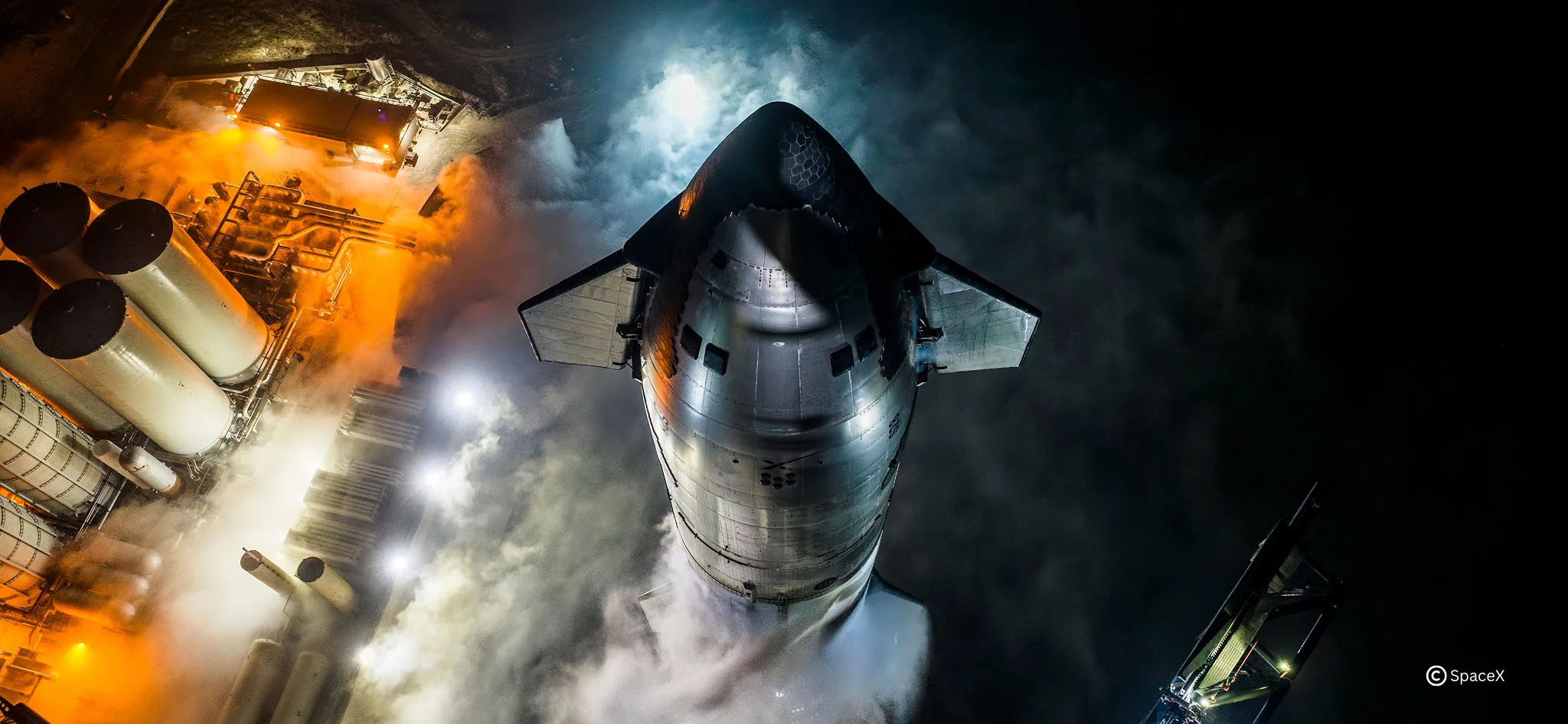
Starship adds another dimension to this logic. Beyond a reusable launcher, it is designed as an industrial system to be manufactured and flown at scale. Its real disruption may therefore be less about lowering commercial launch prices than giving SpaceX an internal cost structure competitors cannot easily match across Starlink, defense, lunar logistics and future orbital infrastructure1.
Super-heavy launchers need captive demand
Super-heavy launchers are hard to justify on third-party demand alone because cadence comes from demand, not technology. Reusable systems become efficient only when they fly often enough to amortize infrastructure and improve operations, making captive demand central.
Starship does not need to wait for mature third-party demand. Starlink now provides regular, high-volume internal demand suited to Starship’s payload capacity, while NASA’s Artemis program adds further cadence through HLS and refuelling launches. Commercial customers may add revenue, but they are unlikely to be the core economic foundation, and their access depends on remaining capacity after SpaceX’s priorities.
What happens to other launchers?
The arrival of super-heavy launch vehicles does not make every other launcher irrelevant. Medium and heavy vehicles may remain attractive where customers value sovereignty, dedicated access, orbital specificity or independence from SpaceX and Blue Origin. Emerging reusable medium launchers such as Neutron and Terran R may also find room if they combine competitive cost, responsive service and sufficient cadence. But the bar is rising. A launcher without captive demand must compete not only on price but against operators with deeper manifests, higher flight rates, lower internal costs and, as the recent New Glenn static-fire explosion showed, the ability to absorb major technical and infrastructure setbacks during ramp-up.
The risk is being too small to benefit from scale, too expensive to challenge Falcon 9, and too late to compete with Starship or New Glenn on capacity. If larger launchers enable even more frequent rideshare or hub-and-spoke logistics through orbital transfer vehicles, dedicated small launchers could face even more pressure.
The real disruption may be in entirely new markets
If super-heavy launchers only launch today’s satellites, their impact will be important but limited. The real disruption would come if they made new orbital systems economically feasible. Lower cost per kilogram is only part of the story. Volume matters too. Larger fairings could reduce the need to miniaturize every component, enabling more modular spacecraft, larger structures and faster industrial deployment. This could change how space infrastructure is designed, assembled and launched.
The most obvious opportunities include orbital stations, in-orbit assembly, propellant depots, lunar logistics, and large-scale orbital infrastructure. Many of these ideas are not new. What is new is the possibility that launch capacity, cadence, and cost could eventually make them less unrealistic.
This is why Starship should not be assessed only as a launcher. It should be assessed as a logistics platform. If it works at scale, it could shift the question from “How do we fit this satellite inside today’s launch constraints?” to “What infrastructure can we now afford to build in orbit?”. That said, lower launch cost does not create a business case by itself, they reduce some financial and technical barriers but can’t eliminate the need for a viable demand and a sustainable business case.
Who captures the value?
Starship and New Glenn should not be understood only as cheaper launchers. The central question is who captures the value created by cheaper access to orbit. A traditional launch provider sells capacity; an integrated operator uses that capacity to strengthen downstream markets, where much of the value lies.
Despite Starship’s high development cost, lower launch costs could give SpaceX a major structural advantage. The recent SpaceX IPO reinforces this logic: capital markets are funding not only a launch provider, but an integrated space infrastructure company built around Starlink, transportation, defense, lunar logistics and future orbital systems. Customers may benefit from lower prices in some cases, but SpaceX has no obligation to pass on the full savings, especially when those savings support its own businesses.
The same logic applies more broadly. Super-heavy launchers may open new markets, but the first movers will likely be those who own the transportation layer. They can create demand internally, experiment faster, and accept lower margins in one segment to win in another. Launch is becoming less a standalone service than the foundation of space infrastructure operations.
For the rest of the industry, this creates both opportunity and risk: lower-cost, high-cadence access could enable systems that were previously impossible, but the benefits may be captured disproportionately by a small number of vertically integrated actors, especially where launch providers are also downstream competitors.
Super-heavy launchers are therefore testing a larger proposition: whether cheaper access to orbit can expand the entire space economy. The winners will not simply be those who reach orbit, but those ready for what cheaper orbit makes possible.