A shift in how space is perceived and organized within defense strategies is underway. What was once treated as a support domain is now becoming a fully operational warfighting domain—recognized for its strategic value, vulnerability, and potential for conflict. With rising tensions, growing budgets, and new military doctrines, the global defense community is confronting the reality that space, like land, air, sea, and cyber, is now a contested operational theatre. For example, the U.S. Space Command now speak of “elements of victory” in space—highlighting resilience, responsiveness, and integration with the joint force as essential traits of a dominant posture in orbit.
Governments are rethinking space doctrine, integration, and capability development—focusing not just on supporting operations, but on enabling space-based command and control (C2), interoperability across services, and closing the space-to-ground kill chain. Space now plays a pivotal role in enabling real-time targeting, coordination, and force projection across domains. As the boundary between commercial and military use blurs and space becomes increasingly weaponized, space-based assets must be protected—and, if necessary, defended as part of an integrated deterrence strategy.
Defense Budgets Shift Toward Space
Governments are rapidly expanding investments to secure independent access to key capabilities, reshaping the architecture of modern militaries. According to our Novaspace Space Defense and Security (SDS) 2024 Report, global government spending on SDS has now reached over $60 billion, more than doubling over five years. These figures mark the baseline for what is now a broader pivot; they do not yet capture the full implications of the past year’s geopolitical acceleration, which has pushed space higher on defense agendas worldwide.
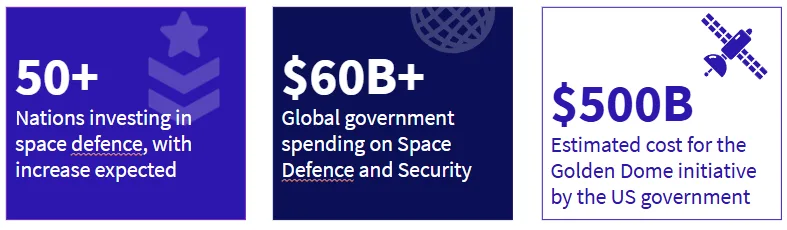
While space currently represents approximately 1.5% to 2.5% of defense spending in the most active countries, its share is expected to grow alongside broader military modernization. As these reforms take shape, we may also see distinct jumps as countries formalize new space commands, fund dedicated programs, and move from pilot efforts to operational capability. Taking Europe as an example, several countries are increasing defense spending toward or over the 2% of GDP mark, and with space claiming a growing share of military priorities, an additional €10–15 billion in space-related spending could, in theory, be unlocked in the coming years. This obviously depends on the review of defense and space strategies in each nation. In line with such dynamics, SDS budgets could rise beyond $80 billion globally by the end of the decade.
This trajectory is not simply about numbers—it reflects a growing consensus: space capabilities are essential for operational sovereignty, deterrence, and resilience. Several countries are institutionalizing space operations—expanding satellite infrastructure, command-and-control doctrine, and national mission planning. Space is no longer a supplementary enabler—it is a prerequisite for success in modern operations.
Building Space Capabilities: Understand, Leverage, Protect
As space transitions into a warfighting domain, military space capabilities are structured around three interconnected functional imperatives: Understand, Leverage, and Access & Protect. This framework reflects how doctrine and capability development are evolving in response to operational demands, from early warning to active defense.

Space Domain Awareness underpins decision-making as it provides visibility and attribution across the orbital environment and beyond—enabling threat detection and intent analysis. The increased focus is also visible in the budget with more than $4 billion allocated to SDA in 2024 as per our Novaspace Space Situational and Domain Awareness Report 2025. National and dual-use SDA systems are expanding, with dozens of new orbital assets planned over the coming decade and growing emphasis on AI-enabled behavioral detection.
PNT, ISR, Satcom, and missile early warning systems have long been foundational space applications and serve as operational enablers across the joint force. In the past, ISR accounted for nearly one-third (around $19 billion as per Novaspace Space Defense and Security Report 2024) of all SDS spending—making it the top-funded capability segment. Similarly, global government spending on secured Satcom now exceeds $10 billion, with the U.S. Department of Defense alone accounting for over $7 billion.
Finally, as military reliance on space intensifies, safeguarding freedom of action and ensuring asset survivability have become central pillars of resilience planning. A new wave of demonstrator missions is targeting space servicing, refueling, and logistics. These areas—currently in early development—are expected to see significant investment over the next decade as they mature into operational capabilities.
Designing the Strategic Foundation for Space Power
Recent policy announcements from the U.S., EU, and Australia emphasize that space must be dealt with through the same strategic rigor as other warfighting domains. One of the most visible reflections of this shift is the U.S. administration’s Golden Dome initiative—a system-of-systems concept aimed at building a space-enabled missile defense architecture that integrates orbital sensors, tracking, and interceptors. While still in its architectural planning phase, Golden Dome signals a pivot toward layered orbital defense and highlights growing expectations for space platforms to play an active role in deterrence and conflict response. Similar ambitions are visible globally: the EU’s IRIS² initiative aims to deliver a multi-orbit secure communications network and Germany has announced plans for a national constellation.
A new framework is emerging—one built around multi-layered deterrence, responsiveness, resilience, and multi-domain integration. Governments are laying the policy foundations for long-term industrial capacity, acquisition models, and the fusion of space operations into joint planning cycles. While international collaboration remains valuable, many governments are also pursuing national projects to accelerate timelines, reduce dependency, and maintain sovereign control. The emerging strategy is not binary but blended: collaborate where it adds scale and resilience, act nationally where faster decision-making, strategic autonomy, or mission-critical urgency require it.
In a domain as dynamic as space, speed of relevance is paramount. That means compressing procurement cycles, adopting spiral development models, and enhancing operational readiness. Space assets must be flexible enough to support evolving CONOPS, just as land, sea, air, and cyber forces increasingly depend on space-based systems to execute their missions. This also includes building up skilled workforces, establishing command and control doctrine, and engaging industry effectively. Capacity building is now a defining issue, with each nation at a different point in its journey, from initial acquisitions to full operational integration. Tailored strategies are needed to reflect differing levels of readiness, ambition, and access to industrial and commercial ecosystems.
Conclusion
There is no single path to space power. Each country must define its own trajectory—based on its strategic needs, budget envelope, industrial base, and alliance posture. Some may focus on sovereign assets. Others may rely on commercial partnerships or defense alliances. What matters is clarity of ambition and the ability to act. Ultimately, each nation must organize its roadmap and procurement strategy in line with its resources, threat perception, and industrial base – defining its own balance between sovereign, commercial, and allied solutions.
As space continues its transformation into a fully contested domain, the challenge for governments is not just technical—it is strategic. Defining the right balance between ambition, capability, and execution will shape the next decade of space defense power projection in orbit—an effort Novaspace is proud to support through data, strategy, and expertise.
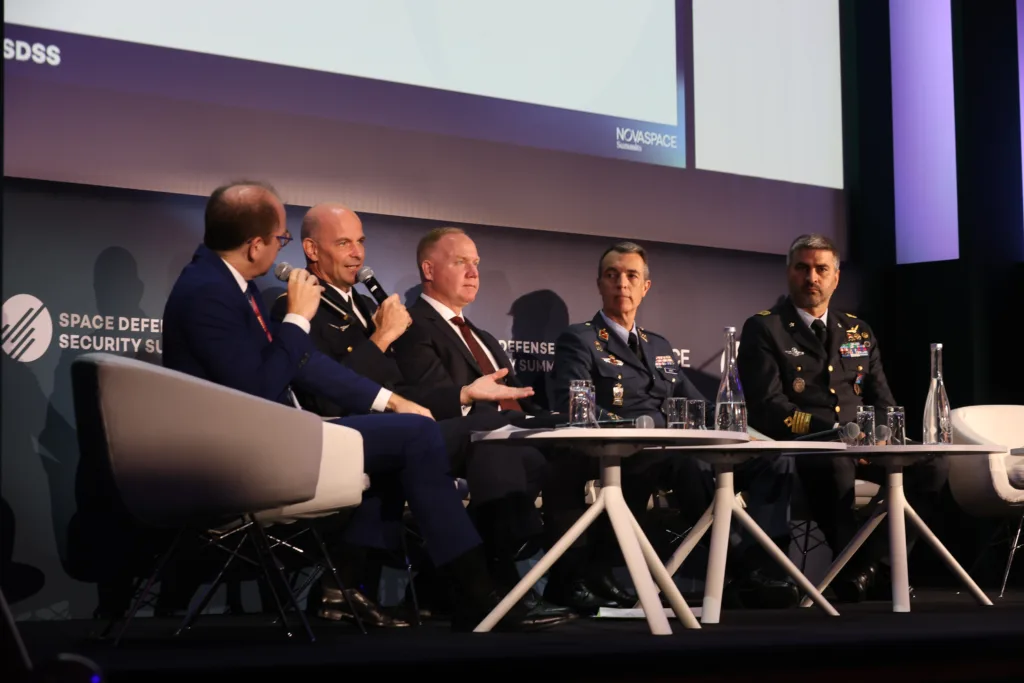
This critical topic will be at the heart of the Space Defense and Security Summit, taking place in Paris in September. The event will convene defense leaders, policymakers, industry stakeholders, and international experts to explore the evolving role of space in defense strategy and foster dialogue on cooperation, capability development, and resilience in the space domain.