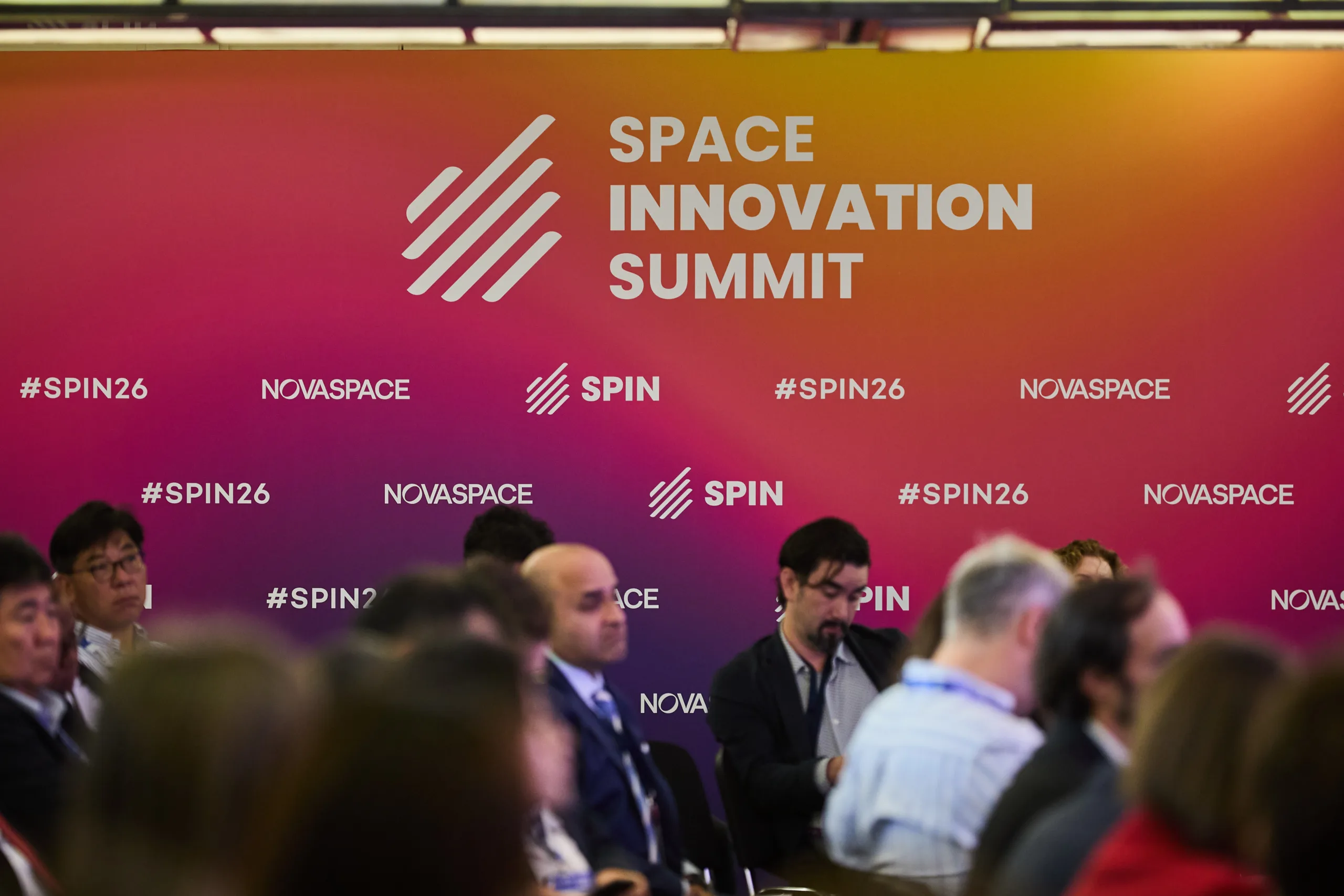
The second edition of SPIN, the Space Innovation Summit, brought together startups, investors, industry leaders, policymakers, and public institutions as part of the World Space Business Week (WSBW) ecosystem in Paris. More than a showcase of emerging technologies, SPIN highlighted how the space sector is maturing into a strategic, globally interconnected industry. Discussions focused on scaling businesses beyond proof-of-concept, accelerating commercialization, strengthening sovereign capabilities, and building the partnerships needed to transform innovation into sustainable growth.
Across conversations on artificial intelligence, orbital computing, dual-use technologies, defense-driven demand, sovereign infrastructure, and new investment models, a consistent message emerged: the next phase of the space economy will be shaped not by technological breakthroughs alone, but by the ability to industrialize, scale, and operationalize innovation.
Seven themes consistently emerged across the week’s discussions and offer a clear view of where the industry is headed next.
1. The Industry Is Shifting from Technology Demonstration to Commercial Scale
The clearest message throughout the summit was that technical success alone is no longer enough. Investors are increasingly prioritizing commercial viability, customer demand, and scalable business models over breakthrough technology. Several investors emphasized that startups must move beyond proof-of-concept and demonstrate contracted pipelines, market traction, and a clear path to growth.
2. Sovereignty Is Becoming a Primary Investment Driver
National security, strategic autonomy, and sovereign capability are reshaping investment priorities across the space sector. Examples included European efforts to develop independent Earth observation data supply chains, growing emphasis on sovereign space infrastructure in quantum technologies, and increasing defense-driven demand across both startup and investor discussions.
SPIN participants repeatedly highlighted that countries are seeking to reduce external dependencies and build domestic capabilities in critical space technologies. Sovereignty is no longer solely a policy objective but a key driver of investment and market demand.
3. AI Is Evolving from a Tool into an Autonomous Operator
Artificial intelligence is rapidly moving from supporting analysis to becoming an operational layer of space infrastructure. Discussions highlighted onboard AI processing, autonomous mission operations, multimodal data analysis, and future AI agents capable of recommending or executing actions.
Companies such as Mission Space demonstrated how real-time space environment monitoring can support satellite operations, while multiple speakers outlined a future in which AI-enabled spacecraft operate with minimal human intervention. Concepts such as planetary intelligence, digital twins, and autonomous space systems emerged as major long-term opportunities.
4. Orbital Computing Is Emerging as the Next Major Infrastructure Market
Several sessions identified orbital computing, in-space processing, and future space-based data centers as some of the largest long-term growth opportunities for the industry.
SpaceLocker showcased a cloud-like model for orbital infrastructure, enabling customers to deploy applications in space in much the same way cloud providers transformed terrestrial computing. Investors and operators also highlighted orbital data centers as an emerging investment theme, while startups discussed the challenges of power generation, thermal management, and scaling in-space computing infrastructure.
5. Industrial Scale Is the New Competitive Advantage
Across launch and manufacturing discussions, success was increasingly defined by industrialization rather than innovation alone.
ESA Aerospace emphasized that “orbit is proof, but scale is the mission,” outlining plans to increase launch cadence through automation and factory-first operations. The discussion reflected a broader industry transition from bespoke engineering and prototype development toward repeatable, high-volume manufacturing enabled by robotics, automation, and digital workflows.
As space markets mature, competitive advantage is shifting from proving technical capability to demonstrating the ability to manufacture and deliver at scale.
6. Defense Is Accelerating Commercial Growth
Many participants identified defense and security markets as the strongest source of demand for emerging space companies. Startups are increasingly pursuing dual-use business models that serve both commercial and government customers, creating more resilient revenue streams and clearer pathways to scale.
The defense-focused panel highlighted growing demand for responsive surveillance, space domain awareness, and capability-based procurement, while investors noted that sovereign security budgets now provide some of the strongest market signals for early-stage companies. The result is a growing convergence between commercial innovation and defense requirements.
7. Partnerships Are Creating New Markets
One of the most distinctive themes of the summit was the growing role of partnerships beyond the traditional space sector.
Kering highlighted how space-derived materials such as aerogel could find commercial applications in luxury products, while discussions explored how aerospace can adopt development methodologies from motorsport to accelerate innovation cycles. Programs such as Cassini, the European Innovation Council (EIC), and regional initiatives in Maharashtra demonstrated how governments, investors, corporates, and startups are working together to accelerate commercialization.
The message was clear: future growth will be driven as much by ecosystem collaboration as by technological breakthroughs.
Looking Ahead
The defining takeaway from the Space Innovation Summit was that the sector is entering a new phase of maturity. Companies such as SpaceLocker, Mission Space, and ESA Aerospace, alongside initiatives including Cassini, the EIC, and the Maharashtra SpaceTech ecosystem, highlighted a common trend: the focus is shifting from invention to execution.
The next generation of winners will be defined not only by technological innovation, but by their ability to scale, commercialize, and build enduring market positions. Long-term success will increasingly depend on combining sovereign relevance, AI-enabled capabilities, industrial-scale operations, and strategic partnerships.
The foundations of the next decade of growth are being laid today.
Save the date for next edition: September 15, 2027.
